01 — The Nights
September, not July.
In La Taxe Canicule, we showed that October is the worst month during the day — not July. At night, September takes over. The harmattan that moderates July nights is gone by September.
The harmattan protects July
The harmattan is a dry wind that blows off the Sahara. During the day it's miserable — dust everywhere, skin cracking, air you can taste. But at night it does something nobody notices: it pulls heat away. Dry air doesn't hold heat the way humid air does. So July nights cool down. Only 5% of them stay above 26°C.
September is the exact opposite. The harmattan is gone. Monsoon humidity pushes up from the south. The air is heavy and still. Heat that the city's concrete and sand absorbed during the day has nowhere to go. It radiates all night. The thermometer doesn't drop. The body doesn't recover. Sleep doesn't come.
69% of September nights never drop below 26°C. That's more than two out of three. October follows at 44%. August matches it. Together, these three months form the season when Nouakchott stops sleeping.
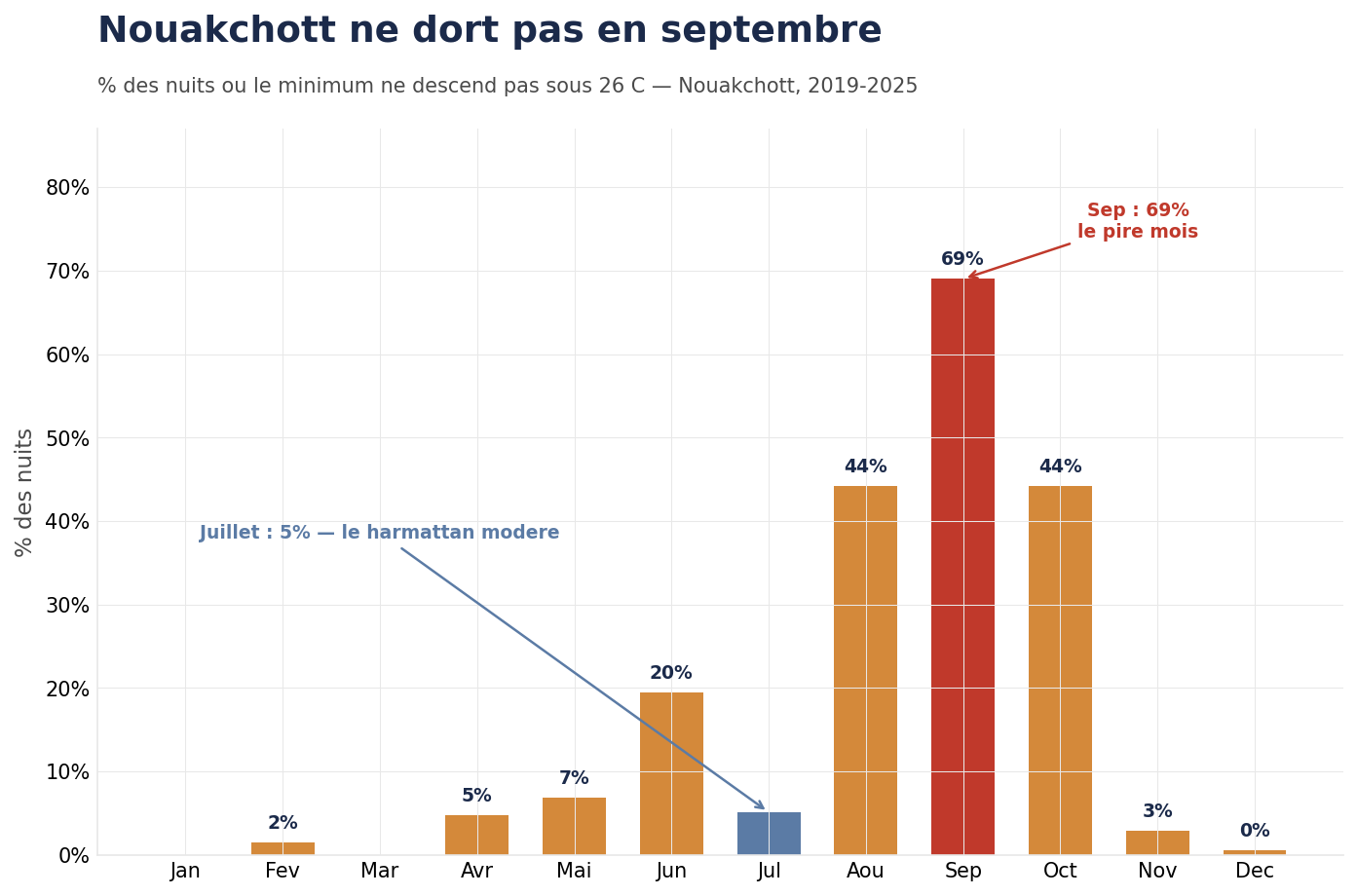
Nouakchott, 2019–2025. Threshold: nighttime minimum > 26°C.
Why 26°C
The WHO standard for a "tropical night" is 25°C. That threshold was designed for European cities where 25°C at night is a rare event. In Nouakchott, 25°C at night is a pleasant evening. It doesn't describe anything people actually experience as hard.
We use 26°C. It's still conservative for a Sahelian city used to heat. But it's the point where the medical literature shows concrete effects: sleep fragments, cardiovascular recovery stops, mortality rises — particularly among the elderly, young children, and workers who spent the day in the sun.
We declare this choice explicitly. The WHO threshold is cited. Ours is justified. If someone wants to recalculate at 25°C or 28°C, all the raw data is available and the methodology is transparent.
Declared assumption
Hot night threshold: 26°C (nighttime minimum between 6PM and 6AM).
Reason: WHO 25°C designed for temperate latitudes. 26°C is conservative for Nouakchott and corresponds to sleep disruption thresholds documented in tropical epidemiological literature.
The shape of the night
This chart shows what happens hour by hour between 6PM and 6AM in Nouakchott, comparing the worst month to the best. In September, the temperature at 6PM is above 30°C. It drops slowly — very slowly — and hits its minimum around 5AM. But that minimum stays above 26°C. There is no point in the night when the body can cool down.
In January, the opposite. Temperature falls fast after sunset and drops below 20°C before midnight. The body recovers. Sleep comes naturally. That's the difference between a city that functions and a city that survives.
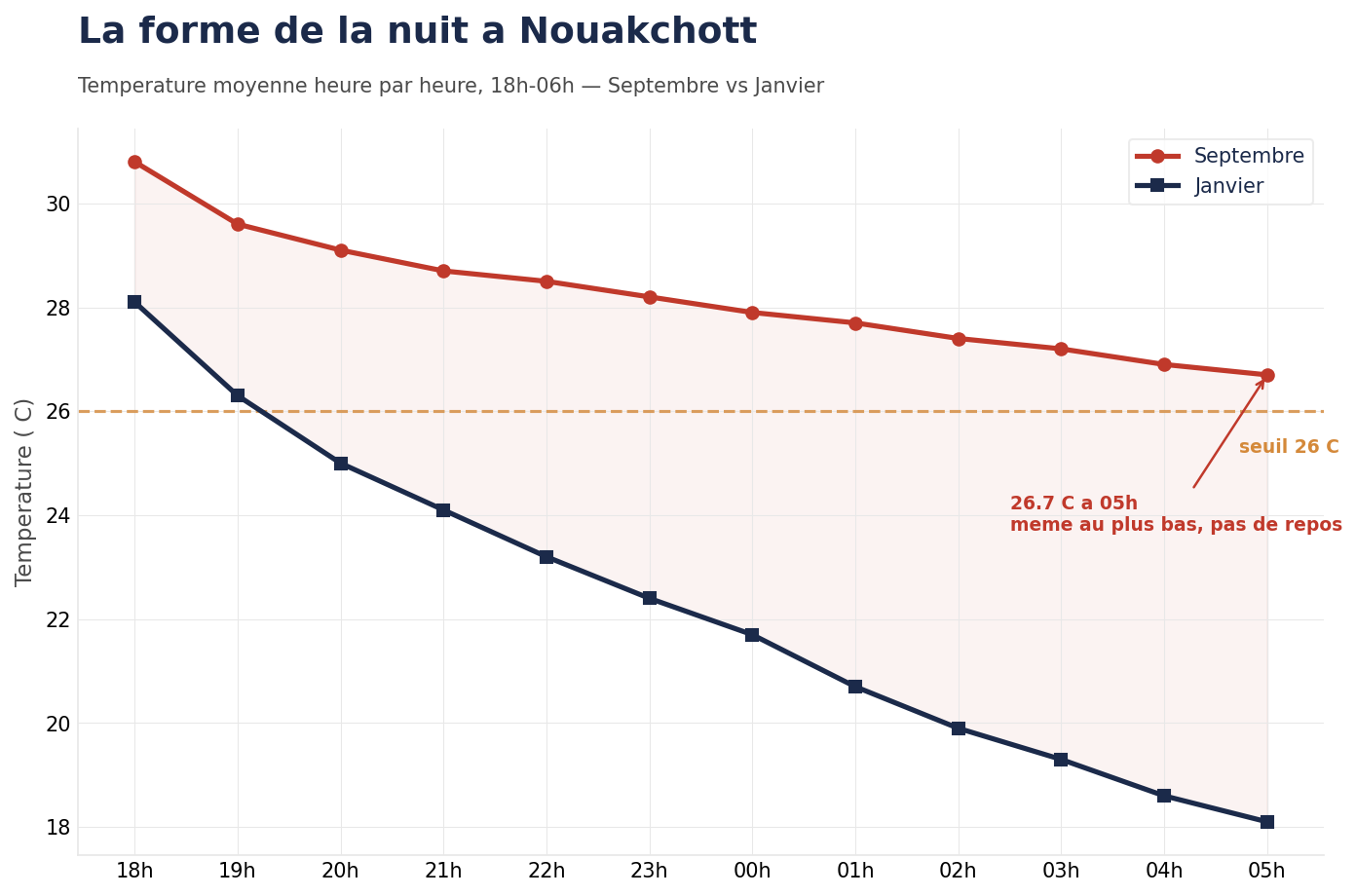
Nouakchott, 2019–2025. Average temperature from 6PM to 6AM.
Month by month
The full breakdown of hot nights by month, averaged over 2019–2025. Winter months (November through March) are almost entirely spared. April and May start to feel the heat. June marks the start of the season at around 20%. July is the paradoxical dip — the harmattan. And then August, September, October: the red block that returns every year.
"The hottest month during the day is not the hardest at night. You only find that out when you count."